
Tidak ada produk di keranjang.

DAPPRA DPR-0640-NPN-NC Industrial Area Sensor Safety Light Curtain Installation Guide
⚠ Installation Guide
DPR-0640-NPN-NC Installation & Safety Integration Guide
A practical guide to installing the DAPPRA DPR-0640-NPN-NC — covering safety distance calculation, hazard-zone placement, machine stop integration, E-stop circuit wiring and environmental protection.
⚠ Safety-Critical Data
Safety Distance Formula
FormulaS = K × (T + C)
K (approach speed)mm/s
T (stop time)Sensor + Machine
Sensor Response<5 ms
StandardISO 13855
Safety LevelSIL 2
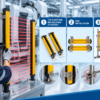
Safety Distance Calculation
Machine Stop Integration
E-Stop Circuit Wiring
Environmental Protection
Introduction
The DAPPRA DPR-0640-NPN-NC is a 6-beam Industrial Area Sensor and Safety Light Curtain designed for object detection, machine protection and personnel protection. This guide focuses on the safety-critical aspects of installation: safety distance calculation, hazard-zone placement, machine-stop integration, E-stop circuit wiring and environmental protection.
Product Specifications
DPR-0640-NPN-NC · Industrial Area Sensor & Safety Light Curtain
View technical specifications, wiring, dimensions and installation reference.
View DPR-0640-NPN-NC Product Page →
Safety Distance Calculation
The safety distance is the minimum distance between the light curtain and the machine hazard zone. It ensures that the machine comes to a complete stop before a person can reach the hazard.
S = K × (T + C)
Where S = minimum safety distance (mm), K = approach speed (mm/s), T = total stopping time (sensor response + machine stopping time), and C = additional distance depending on resolution.
Where S = minimum safety distance (mm), K = approach speed (mm/s), T = total stopping time (sensor response + machine stopping time), and C = additional distance depending on resolution.
For the DPR-0640-NPN-NC with a 40 mm resolution and <5 ms response time, engineers must combine the sensor response time with the machine stopping time and apply the appropriate standard (e.g., ISO 13855) to determine the correct safety distance.
Hazard-Zone Placement
The DPR-0640-NPN-NC should be installed at a distance from the machine hazard that is equal to or greater than the calculated safety distance.
- Verify the machine stopping time — Measure or obtain it from the machine builder.
- Combine with sensor response time — Add <5 ms to the machine stopping time.
- Apply the appropriate safety distance standard — Use ISO 13855 or local equivalent.
- Install at or beyond the calculated distance — Never install closer.
Machine-Stop Integration
The DPR-0640-NPN-NC provides an NPN NC output signal. This output cannot directly stop a machine on its own — it must be connected to a safety relay, safety controller or a control system capable of safely removing power from the machine.
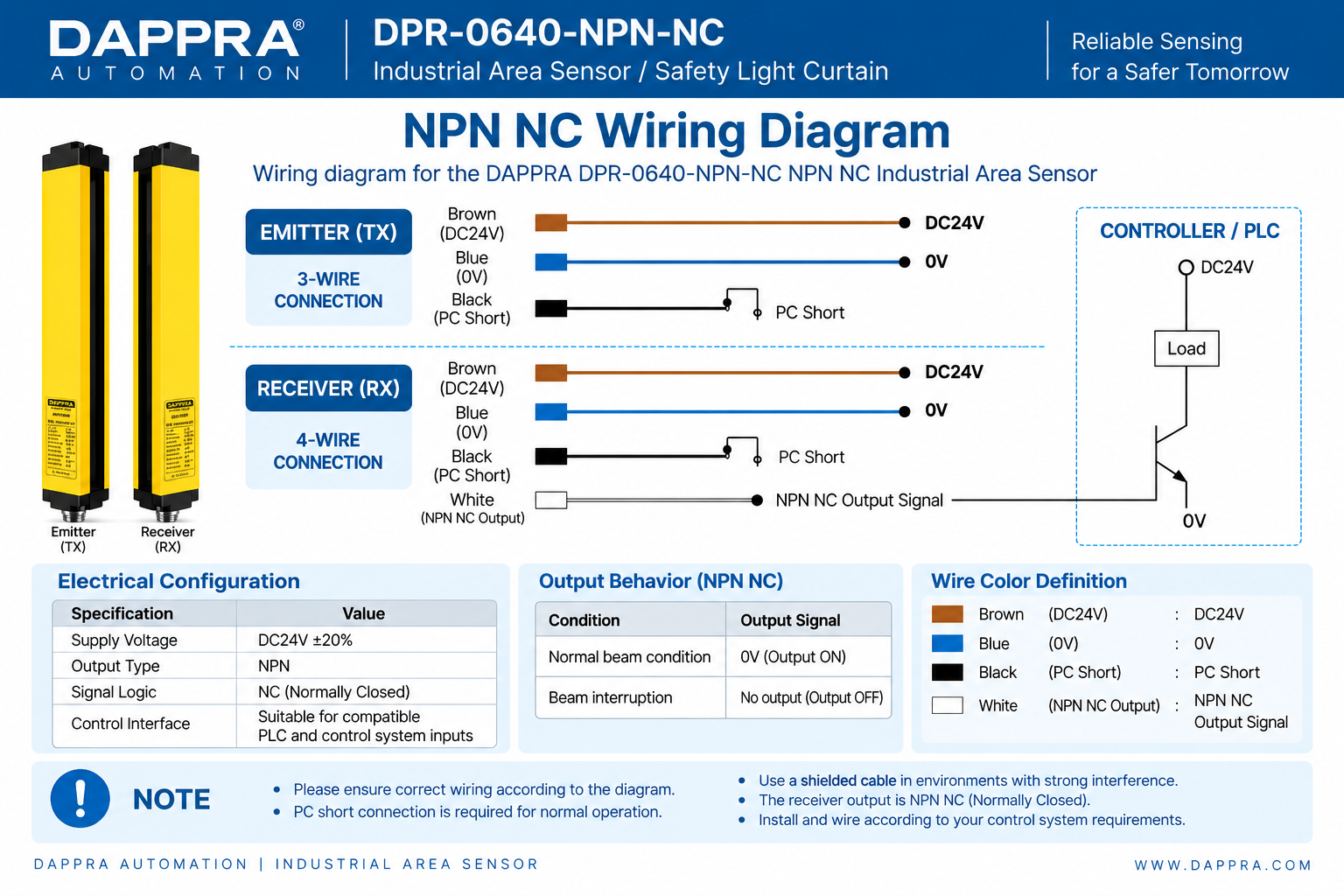
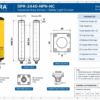
Wiring diagram for the DPR-0640-NPN-NC NPN NC Industrial Area Sensor
Emergency Stop Circuit Wiring
- Connect the sensor output to the safety relay input — Use the NPN NC output.
- Connect the E-stop button to the safety relay input — Same safety circuit.
- Connect the safety relay output to the machine contactor — Controls machine power.
- Verify the safety function — Test both the light curtain and the E-stop independently.
⚠ WARNING: A safety light curtain must never be used as the only
means of machine stop. The safety function must be implemented using a properly
rated safety relay or safety controller, in accordance with the machine risk
assessment and applicable safety standards.
Environmental Protection
- Avoid direct sunlight — Install a sun shield if exposed.
- Avoid reflective surfaces — Reflective surfaces can cause false detection.
- Keep the lens clean — Dust, oil and moisture reduce reliability.
- Use shielded cables — Protect from electromagnetic interference.
- Maintain operating temperature — Operate within -10°C to +55°C.
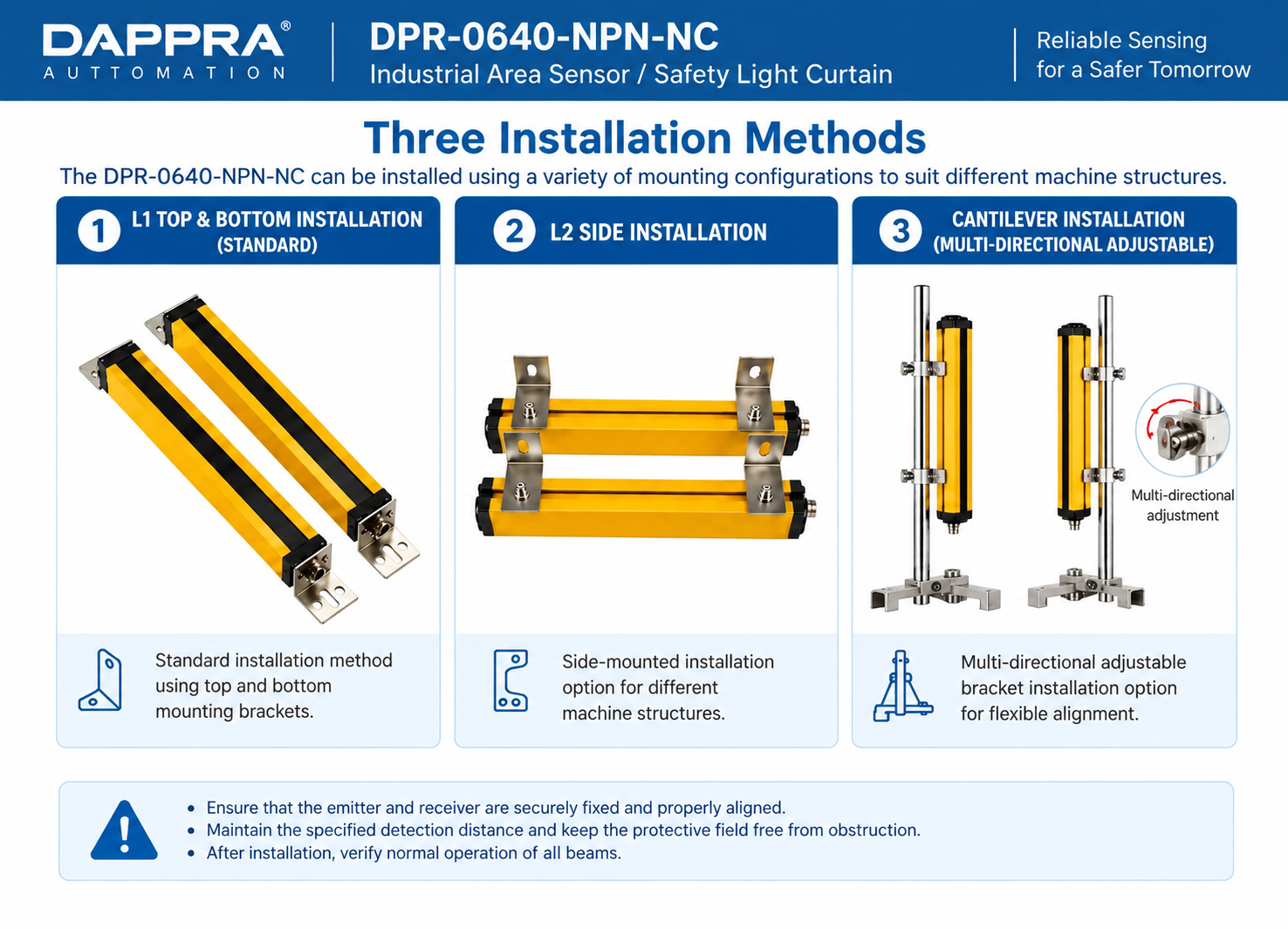
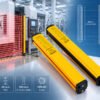
Installation options for the DPR-0640-NPN-NC Area Sensor
Package Contents
- 1 × Transmitter — Infrared beam transmitter
- 1 × Receiver — Infrared beam receiver
- 2 m connection cables — Pre-terminated cables
- M12 connection — Standard industrial connector
- Mounting accessories — Brackets and screws
Full Documentation
DPR-0640-NPN-NC · Datasheet, Installation Guide & CAD Drawing
Access complete technical documents and purchasing information for this model.
View DPR-0640-NPN-NC Product Page →
Frequently Asked Questions
How do I calculate the safety distance for a light curtain?
+
The safety distance is calculated using the formula S = K × (T + C), where K is the approach speed, T is the total stopping time (sensor response time + machine stopping time), and C is the additional distance depending on the resolution. Always apply the applicable standard, such as ISO 13855, to determine the correct safety distance for your specific installation.
How far should a safety light curtain be installed from a machine hazard?
+
The light curtain must be installed at a distance equal to or greater than the calculated safety distance. This distance ensures the machine stops before a person can reach the hazard. Never install the light curtain closer than the calculated safety distance, even if the physical space allows it.
Can a safety light curtain directly stop a machine?
+
No. A safety light curtain provides a detection signal, but it cannot directly stop a machine on its own. The sensor output must be connected to a safety relay, safety controller or a control system capable of safely removing power from the machine. The safety function must be implemented as part of the machine’s overall safety architecture.
How do I connect a safety light curtain to an emergency stop circuit?
+
Connect the light curtain output (NPN NC) and the emergency stop button to the same safety relay or safety controller input. The safety relay monitors both signals and removes power from the machine’s hazardous motion when either the light curtain is interrupted or the E-stop is pressed. Verify the safety function by testing both the light curtain and the E-stop independently.
How do I protect a safety light curtain from environmental interference?
+
Avoid direct sunlight, reflective surfaces and strong ambient light near the sensor. Keep the lens clean from dust, oil and moisture. Use shielded cables to protect the signal from electromagnetic interference. Operate the sensor within its rated temperature range of -10°C to +55°C and maintain the IP65 protection rating.
Need help with safety integration for your machine?
Our engineers can assist with safety distance calculation, machine-stop integration, E-stop circuit wiring and selecting the right DPR Series model for your application.











Tambah komentar
Anda harus masuk untuk berkomentar.