
Tidak ada produk di keranjang.

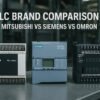
PLC Brand Comparison: Mitsubishi vs Siemens vs Omron — How to Choose the Right One?
1. Introduction
Choosing a PLC brand is one of the most important decisions in automation engineering.
Engineers rarely choose a PLC based only on pricing — real considerations include:
- System compatibility
- Stability and long-term reliability
- Availability of modules
- Software ecosystem
- Industrial standards and communication support
- Existing equipment or customer preferences
- Budget and maintenance cost
This article compares the three most widely used PLC brands: Mitsubishi, Siemens, and Omron, helping you decide which brand best fits your project.
2. Brand Fundamentals
Mitsubishi PLC
- Affordable, widely used in Asia
- Easy to program
- Strong support for small to mid-size machinery
- Excellent cost–performance ratio
Siemens PLC
- Industry-leading performance & stability
- Best-in-class communication capability
- Ideal for complex production lines
- Global ecosystem, widely adopted in large manufacturing plants
Omron PLC
- Strong integration between sensors + control
- Excellent for inspection + motion + logic combined systems
- Good for machine vision and high-precision equipment
3. Architecture & System Differences
Software Comparison
| Brand | Software | Difficulty | Notes |
|---|---|---|---|
| Mitsubishi | GX Works2/3 | Easy | Friendly interface, fast to learn |
| Siemens | TIA Portal | Hard | Very powerful, steep learning curve |
| Omron | CX-Programmer / Sysmac Studio | Medium | Strong integration with motion & vision |
Scan Cycle & Execution Speed
- Siemens generally offers the fastest cycle time & most consistent deterministic behavior
- Mitsubishi performs well for typical machinery
- Omron is optimized for synchronized control + sensor systems
Communication Capability
| Protocol | Mitsubishi | Siemens | Omron |
|---|---|---|---|
| Modbus | Yes | Yes | Yes |
| Ethernet/IP | Optional | Yes | Supported |
| Profinet | Limited | Strong | Optional |
| EtherCAT | No | No | Strong |
Siemens Profinet is the industrial standard for large-scale automation.
Omron EtherCAT is the best for servo synchronization.
Mitsubishi CC-Link dominates many Asian factories.
4. Application Scenarios
Mitsubishi → Small/Medium Machinery
Common in:
- Packaging machines
- Food processing equipment
- CNC small machines
- General OEM equipment
Siemens → Large-Scale Production Lines
Used in:
- Automotive production
- Pharmaceutical plants
- Chemical plants
- Large distributed I/O networks
Omron → Inspection + Control Integration
Great choice for:
- Vision inspection systems
- High-speed sorting
- Motion control + sensors
- Mechatronics research equipment
5. Parameter Differences & Performance Impact
Instruction Execution Speed
- Siemens: fastest overall
- Mitsubishi: fast enough for most standalone machines
- Omron: optimized for motion & sensor data processing
IO Expansion Capability
- Siemens: unlimited flexibility with remote I/O
- Mitsubishi: compact but adequate
- Omron: modular design focused on machine integration
Stability & Noise Immunity
Siemens > Omron > Mitsubishi
6. Engineering Issue Analysis
Siemens
- Very steep learning curve
- TIA Portal license expensive
- Powerful but heavy for small machines
Omron
- Program structure can be complex
- Sysmac Studio is feature-rich but harder for beginners
Mitsubishi
- Too many module versions
- Compatibility issues between older & newer hardware
7. Best Practices for Choosing PLC
Choose by Industry
- Siemens → automotive, chemical, pharma, heavy industry
- Mitsubishi → CNC, packaging, F&B, OEM machines
- Omron → inspection + motion + sensor integration
Choose by Budget
- Mitsubishi FX series → cost-effective
- Siemens S7-1200 → mid-range high performance
- Omron CP1E / NX1P2 → flexibility + motion
Consider Training & Ecosystem
- Siemens → strong global support
- Mitsubishi → abundant tutorials & Chinese support
- Omron → ideal for vision-integrated systems








Tambah komentar
Anda harus masuk untuk berkomentar.