
Tidak ada produk di keranjang.
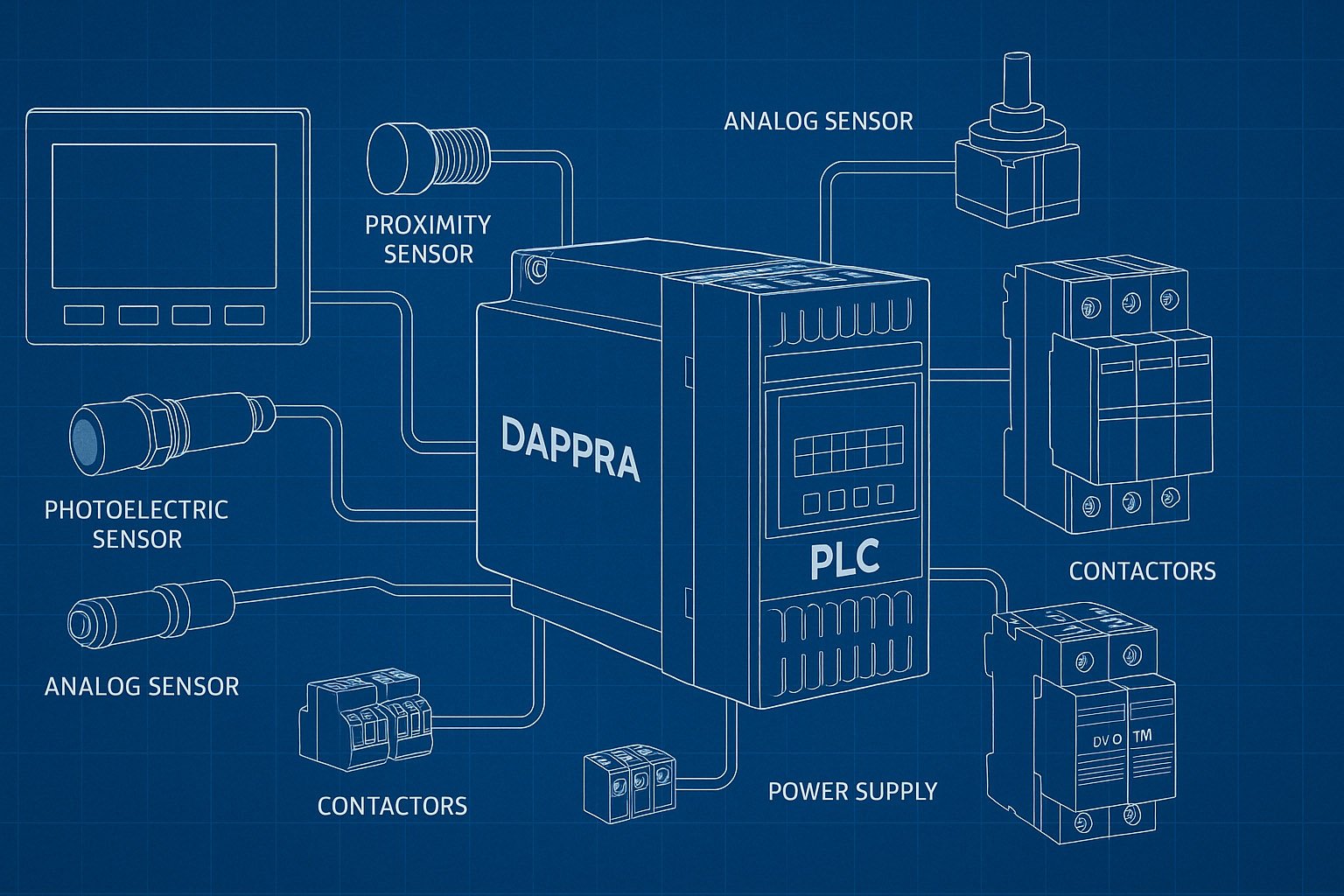
10 Essential Principles Every Industrial Automation Control System Must Follow
1. Introduction — Control System Design Defines Engineering Quality
A well-designed industrial automation control system determines:
- Machine reliability
- Maintenance difficulty
- Safety of operators
- Expandability and lifecycle
- Troubleshooting efficiency
Good design combines electrical, logic, communication, and safety engineering into one unified structure.
This article summarizes the 10 essential principles every engineer must apply.
2. Ten Foundational Principles of Control System Design
Principle 1 — Safety First
Includes:
- Emergency stop circuits
- Limit switches
- Isolation switches
- Safety relays
- Protection layers
Principle 2 — Separate Strong Power and Weak Signals
Avoid noise by separating:
- VFD/motor wiring
- PLC I/O signals
- Sensor wiring
EMI reduction is essential.
Principle 3 — Logical IO Planning
Proper allocation prevents:
- Wiring mess
- Logic duplication
- Difficulty expanding later
Plan digital/analog IO early.
Principle 4 — Modular Logic Design
Program should be:
- Structured
- Separated by function
- Reusable for future machines
Principle 5 — Unified Parameter Naming
Use consistent naming rules:
- Motor_01_Speed
- Sensor_Up_Position
- Alarm_Overheat
Clear naming reduces debugging time.
Principle 6 — Anti-Interference Best Practices
Use:
- Shielded cables
- Proper grounding
- Surge protection
- Filtered power
Principle 7 — Separate Control and Power Supplies
Avoid sharing power between:
- PLC logic
- VFD power
- High inrush loads
Principle 8 — Standardized Grounding
Good grounding ensures:
- Electrical safety
- Stable communication
- Noise immunity
Principle 9 — Complete Documentation
Must include:
- Electrical diagrams
- Wire lists
- PLC IO map
- Parameter logs
Indispensable for maintenance and audits.
Principle 10 — Reserve Expansion Space
Future-proof the design:
- 20–30% cabinet space
- Extra IO slots
- Spare cable ducts
3. Control Flow Architecture
Every control system follows the same structure:
Input → Signal Processing → Output → Feedback
Simple but critical for diagnostics and design planning.
4. Common Design Mistakes
❌ No IO expansion planning
❌ Cabinet layout too crowded
❌ Missing safety components
❌ Poorly documented logic
❌ No EMC protection
5. Engineering Case Examples
Case — Not Enough IO for New Sensors
Adding new functions required extra PLC modules → no space reserved → redesign needed.
Case — PLC Burnout from Surge
No surge protection → lightning-induced transient → module failure.


















Tambah komentar
Anda harus masuk untuk berkomentar.