
Tidak ada produk di keranjang.
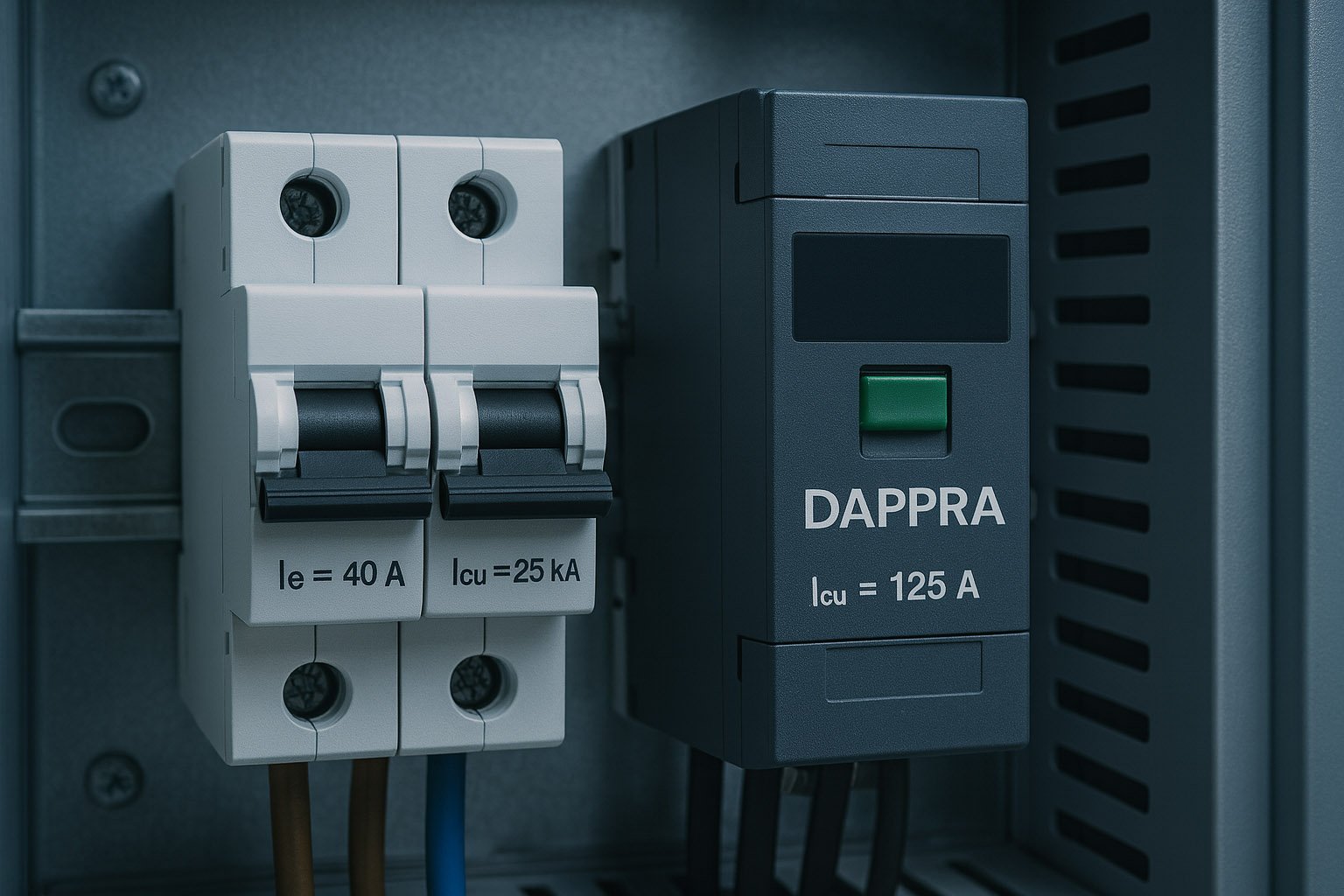
How to Choose a Circuit Breaker (MCB/MCCB)? In-Depth Guide to Rated Current and Breaking Capacity
- Introduction — Circuit Breakers Are the First Line of Protection
In any electrical or automation system, the circuit breaker (MCB or MCCB) is the first and most critical protection component. Incorrect selection can lead to:
Frequent nuisance tripping
Failure to disconnect fault currents
Damaged wiring and equipment
Understanding rated current (Ie) and breaking capacity (Icu) is essential for proper protection.
- Difference Between MCB and MCCB
2.1 MCB — Miniature Circuit Breaker
Used for small loads
Homes, small machinery, light automation
Typically fixed trip characteristics
Compact size
2.2 MCCB — Molded Case Circuit Breaker
Used for large industrial loads
Adjustable overload settings
Higher breaking capacity
Suitable for automation machines, motor feeders, main circuit protection
2.3 Key Structural Differences
MCB = fixed parameters
MCCB = adjustable overload & trip curves
MCCB offers higher safety margin for machines with high inrush currents
- Key Parameters to Understand
3.1 Rated Current (Ie)
Current that the breaker can handle continuously.
3.2 Breaking Capacity (Icu)
Maximum short-circuit fault current the breaker can safely interrupt without damage.
Higher Icu = safer under large short-circuit conditions.
3.3 Number of Poles (1P / 2P / 3P / 4P)
Depends on system phase configuration.
3.4 Trip Curve Type (B / C / D Curve)
B Curve: Fast trip — resistive loads
C Curve: Standard industrial loads (most common)
D Curve: High inrush loads (motors, transformers)
Trip curve selection is crucial for preventing nuisance trips.
- How Breaking Capacity Works
Short circuits produce extremely high currents within milliseconds.
The breaker must:
Detect fault current
Open contact points
Extinguish electrical arc
Remain safe for future operation
High breaking capacity = better arc extinguishing capability.
- Typical Application Scenarios
MCB
Lighting circuits
Small machines
Instrument panels
Control circuits
MCCB
Motors
Heating loads
Automation main switches
Industrial panels needing high Icu
- Common Problems Caused by Wrong Selection
❌ Breaker capacity too low → frequent tripping
❌ Icu too low → breaker fails to clear short-circuit (dangerous)
❌ Trip curve mismatch → unexpected shutdowns
Example: B-curve breaker used for motor → guaranteed nuisance trip.
- Best Practices for Selecting the Right Breaker
✔ Select Ie = load current × 1.25 safety factor
✔ For machinery, MCCB is always safer than low-grade MCB
✔ Ensure Icu meets industrial standards
✔ Always choose certified models (IEC / UL / CE)
✔ High-inrush loads (motors) → C or D curve
Correct breaker selection ensures reliability, reduces downtime, and protects expensive equipment.
















Tambah komentar
Anda harus masuk untuk berkomentar.