
Tidak ada produk di keranjang.
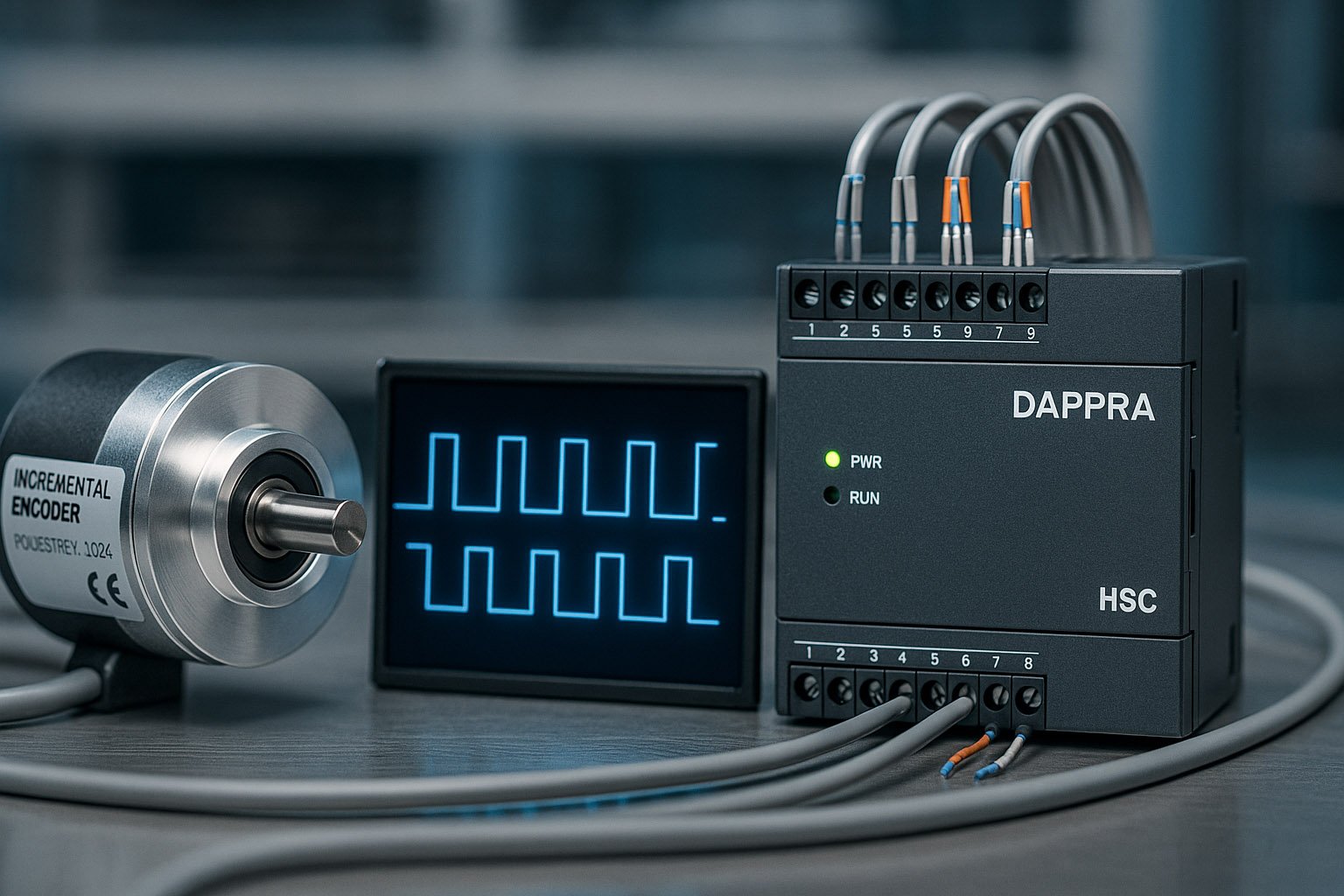
What Is a PLC High-Speed Counter (HSC)? Applications and Working Principles Explained
1. Introduction — Why Standard Scan Cycles Cannot Handle High-Speed Signals
Traditional PLC scan cycles (typically 5–30 ms) are not fast enough to capture:
- High-frequency pulses
- Fast encoder signals
- Rapid counting events
- Speed and position feedback
When signals change faster than the scan time, the PLC misses pulses, leading to:
- Incorrect counts
- Wrong speed calculation
- Position errors
- Equipment malfunction
The High-Speed Counter (HSC) solves this by capturing pulses independently from the main PLC scan, ensuring accurate detection.
2. How High-Speed Counters Work
2.1 Pulse Capture Mechanism
An HSC has a dedicated hardware circuit designed to:
- Monitor high-frequency inputs
- Capture rising/falling edges
- Count pulses asynchronously
- Store values in special registers
It does not rely on the normal ladder logic scan.
2.2 Interrupt-Driven vs Standard Scan
Normal scanning:
PLC scans → then checks input → then updates program
→ High-speed pulses may be missed.
Interrupt-driven HSC:
Hardware triggers → event interrupt → value updates instantly
→ No pulses missed.
2.3 A/B Phase Encoder Processing
Incremental encoders produce:
- A phase
- B phase
- Z index pulse
HSC supports:
- Quadrature decoding (detect direction)
- X1 / X2 / X4 multipliers
- High-speed direction tracking
This allows position and speed measurement in real time.
3. Types of HSC
3.1 Single-Phase Counting
Counts:
- Rising edges
- Falling edges
Used for simple pulse counting.
3.2 Dual-Phase (A/B Phase) Counting
Detects:
- Direction
- Quadrature pulses
- Position changes
Used for encoders and servo feedback.
3.3 Direction Control Counting
One channel for pulse count + one input for direction control.
Common on conveyors.
3.4 Frequency Measurement
PLC measures:
- Pulse frequency
- Speed
- RPM
by calculating pulses per time interval.
4. Common Application Scenarios
4.1 Encoder Speed Measurement
Used in:
- Conveyors
- Rollers
- Printing machines
- CNC spindle feedback
Provides accurate RPM and linear speed.
4.2 Packaging Line Counting
Counts:
- Bottles
- Boxes
- Products on conveyor
HSC eliminates missed counts even at high line speeds.
4.3 CNC Tool Monitoring
Monitors:
- Tool rotation
- Feed rate synchronization
- Position feedback
Ensures precision machining.
4.4 Conveyor Position Detection
Encoder counts are converted into:
- Position
- Distance
- Travel length
Useful for cutting machines and labeling.
5. Signal Wiring and Electrical Requirements
5.1 Encoder A/B/Z Channel Wiring
HSC supports:
- A
- B
- Z (index pulse)
Z resets the counter each rotation.
5.2 Shielding and Grounding
Encoder cables must be:
- Shielded
- Properly grounded
- Kept away from strong EMI sources
Improper grounding causes pulse noise.
5.3 24V Pulse Conversion
If using open-collector or differential encoders, a conversion module may be needed to match PLC input specs.
6. Common Issues with HSC
6.1 Pulse Jumping (Count jumps unexpectedly)
Usually due to:
- Noise interference
- Poor shielding
- Wrong pull-up resistor
6.2 Double Counting / Multiple Pulses
Often caused by:
- Debounce settings too low
- Incorrect input filter
- Electrical noise on A/B channels
6.3 Missed Pulses at High Speed
Causes:
- Using normal input instead of HSC input
- Wiring too long
- Weak signal strength
7. Best Practices
✔ Use Differential Signal Inputs (A+/A-, B+/B-)
Greatly improves noise immunity.
✔ Keep Encoder Cables Away from VFDs and Servo Drives
Reduces EMI.
✔ Use Dedicated High-Speed Input Terminals
Never connect encoder signals to normal DI inputs.
✔ Optimize Filtering and Debounce Settings
Balance between noise rejection and responsiveness.
















Tambah komentar
Anda harus masuk untuk berkomentar.