
Tidak ada produk di keranjang.
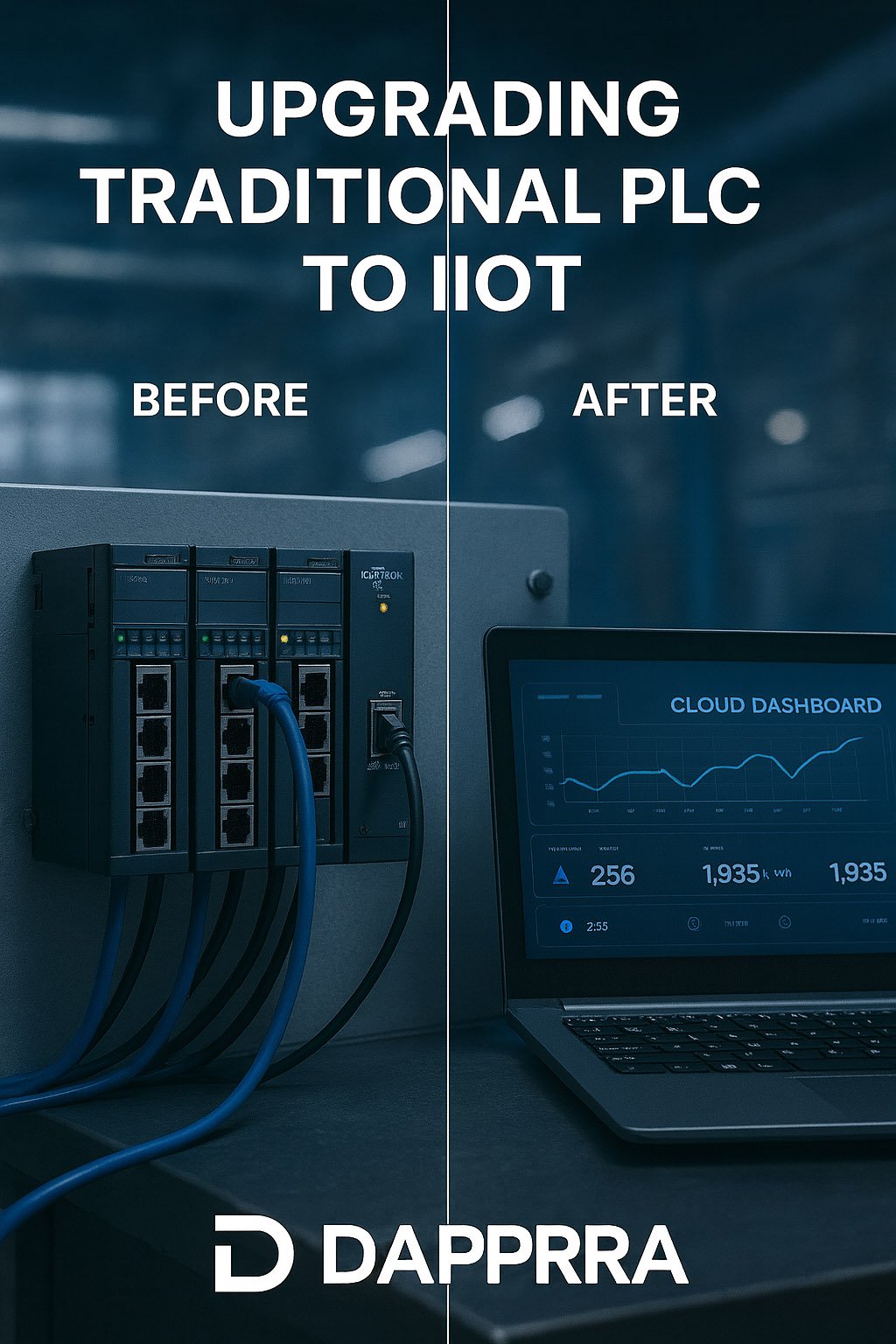
How Factories Can Upgrade from Traditional PLC to Industrial IoT (IIoT)
1. Introduction — The Three Main Goals of PLC → IIoT Upgrades
More and more factories are upgrading traditional PLC-based automation into Industrial IoT (IIoT) systems.
The upgrade is driven by three major goals:
- Visualization — View machine and production data in real time
- Remote Access — Diagnose and service equipment from anywhere
- Data Intelligence — Use data for analytics, decision-making, and optimization
Traditional PLCs are powerful for local control, but they lack the connectivity and data capabilities required by modern factories.
2. Structural Differences: Traditional PLC vs IIoT
2.1 Traditional PLC System
Characteristics:
- Closed system
- Local-only data
- Hardwired communication
- Program stored internally
- Logic-focused, not data-focused
This structure creates limitations:
- No remote visibility
- Hard to integrate with cloud platforms
- No machine-to-machine analytics
2.2 IIoT Architecture
Characteristics:
- Open and connected
- Cloud-driven
- Highly interoperable
- Visualization and analytics built-in
- Multi-layer communication
IIoT transforms PLC data from local-only to factory-wide, multi-site, and cloud-accessible.
3. Upgrade Architecture Design
The most practical and widely adopted IIoT upgrade approach is adding an industrial gateway to existing PLC systems.
3.1 Add an Industrial IoT Gateway
The gateway performs:
- Data extraction from PLC (Modbus, S7, FINS, Ethernet/IP)
- Edge computing
- Buffering and filtering
- Publishing to cloud via MQTT / HTTPS
- Alarm logic and event detection
No PLC replacement is needed.
3.2 Add Additional Sensors for Data Gaps
Traditional PLC systems may not collect:
- Motor current
- Vibration
- Temperature
- Power consumption
- Machine cycle signals
Adding these sensors greatly enhances data completeness.
3.3 Build MQTT or OPC-UA Data Layer
Two IIoT standard protocols:
- MQTT → Cloud-first, lightweight
- OPC-UA → Enterprise-level industrial integration
This allows scalable, secure, and structured communication.
4. Signal Flow — PLC → Edge Gateway → Cloud Platform
4.1 Data Sampling Cycle
PLC updates internal registers at a scan rate (e.g., 10–50 ms).
Gateway reads these values at:
- 500 ms
- 1 sec
- 5 sec
depending on project requirements.
4.2 MQTT Topic Structure
A clean topic structure ensures good organization:
Examples:
factory1/machine01/statusfactory1/machine01/temperaturefactory1/machine01/alarms
Good naming conventions make multi-machine dashboards easy to implement.
4.3 Cloud Processing
Cloud platform functions:
- Alarm notifications
- Trend analytics
- KPI dashboards
- Mobile app access
- Production reporting
5. Step-by-Step Upgrade Phases
IIoT upgrades should be implemented incrementally to avoid risk.
Phase 1: Data Collection
Start with basic values:
- Temperature
- Speed
- Status bits
- Production count
Phase 2: Alarm Push Notifications
Send error and warning messages:
- Telegram
- Mobile app
- SMS
Phase 3: Visualization Dashboard
Create dashboards for:
- Real-time status
- Trends
- Production KPIs
- OEE
Phase 4: Predictive Maintenance
Use data for:
- Motor current monitoring
- Vibration analytics
- Failure prediction
- Energy optimization
This is the final stage of IIoT maturity.
6. Engineering Problems in IIoT Upgrades
6.1 Old PLC Models Lack Communication Ports
Solutions:
- Use serial converters
- Add communication modules
- Read data through I/O tapping (limited)
6.2 Unstable Network on Factory Floor
Causes:
- Poor Wi-Fi
- Interference
- Router overload
- High device density
Solutions:
- Add industrial-grade switches
- Use wired Ethernet where possible
- Use 4G/5G backup
6.3 Excessive Data Causing Cloud Congestion
Solutions:
- Reduce sampling rate
- Use edge filtering
- Send only changes (delta upload)
- Compress payloads
7. Best Practices for PLC → IIoT Upgrades
✔ Use a layered structure
Device → Gateway → Cloud keeps systems stable and scalable.
✔ Use buffering to avoid data loss
Gateways must store data during:
- Network disconnect
- Server downtime
- Power fluctuations
✔ Build redundancy
Ensure:
- Backup communication paths
- Failover servers
- Alarm escalation hierarchy
✔ Start small, expand in phases
Avoid attempting full IIoT transformation in one step.



















Tambah komentar
Anda harus masuk untuk berkomentar.