
Tidak ada produk di keranjang.

How to Choose the Right Sensor Cable for Automation Equipment
Choosing the Right Sensor Cable for Industrial Automation
Selecting the correct sensor cable is one of the most important decisions in automation engineering. A poorly chosen cable may introduce electrical noise, cause intermittent signals, fail under mechanical stress, or degrade prematurely when exposed to oil, heat, or movement. In contrast, a properly specified cable ensures long-term stability, accurate signal transmission, and trouble-free maintenance. Understanding cable construction, materials, shielding methods, and application requirements is essential for achieving reliable system performance.
Cable Structure and Outer Jacket Materials
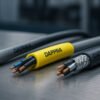
The outer jacket material determines how well the cable withstands mechanical and chemical exposure. PVC is commonly used for standard environments where the cable remains stationary and is not exposed to aggressive substances. It is flexible and cost-effective, making it suitable for general-purpose sensor connections.
PUR jackets, by contrast, provide far superior resistance to oil, abrasion, and continuous motion. These properties make PUR cables the preferred choice for drag-chain applications, robotic arms, automated machinery with repeated motion, and areas exposed to cutting fluids. The internal conductor structure also affects durability. Finely stranded copper conductors improve flexibility and minimize fatigue during continuous bending cycles, while reinforced tensile elements help prevent stretching or internal wire rupture.
Shielding and Noise Protection
Shielding is a critical design element that directly affects signal quality. Industrial environments often contain variable frequency drives, switching power supplies, and high-current loads that generate electromagnetic interference. A cable without shielding is likely to pick up noise, resulting in unstable sensor readings, false triggers, or PLC misinterpretations.
Foil shielding provides basic protection for low-noise applications, while braided shielding offers significantly higher coverage and superior noise rejection. Some high-end sensor cables combine both foil and braid layers for maximum protection. In addition, proper grounding technique—such as single-point grounding of shielded cables—improves system immunity and prevents ground loops.
Electrical Characteristics and Performance
The electrical properties of a sensor cable influence how the signal behaves over distance. Capacitance affects analog sensor accuracy, while insulation breakdown voltage determines how well the cable handles spikes or transient conditions. Low-capacitance cables are essential for long-distance analog signals or high-frequency measurement devices. High-quality insulation materials also ensure long-term dielectric stability, even in environments with moisture, chemicals, or temperature variations.
Matching Cables to Application Scenarios
Different environments place different demands on the cable. Stationary, low-stress applications can safely use PVC-jacketed cables. For cable tracks or robotics, high-flex PUR cables rated for millions of bending cycles are essential. When noise is a concern—such as when cables run near VFD output lines or power conductors—shielded cables are mandatory.
Some applications require even more specialized cables. Vision systems or high-speed encoders need cables with extremely low capacitance and robust shielding. Encoders and servo motors typically require double-shielded cables to protect sensitive feedback signals. In corrosive or chemical environments, specialized jackets resist degradation from oils, solvents, and cleaning agents.
Common Engineering Errors
A frequent mistake is using standard PVC cables in drag-chain applications. PVC fatigues rapidly, leading to cracking and conductor breakage. Another issue arises when unshielded sensor cables run in the same tray as motor power cables. This often results in false readings or intermittent sensor trips. Engineers also sometimes overlook cable length limits, causing analog voltage drops or encoder signal distortion. Finally, improper grounding of shielded cables can introduce noise rather than eliminating it.
Installation Techniques for Reliable Operation
Good installation practices are just as important as proper cable selection. Grouping cables by type—such as separating power cables from signal cables—reduces interference. Maintaining appropriate minimum bend radii prevents mechanical stress. Ensuring uninterrupted shield continuity, especially when passing through junction boxes or terminal blocks, preserves noise immunity. Proper strain relief prevents connector stress and prolongs cable life.
Best Practices for Optimal Reliability
Engineers should use shielded cables for servo motors, encoders, and high-precision sensors. Drag-chain applications require PUR jackets and construction rated for millions of bending cycles. Sensor cables should be routed away from VFD power wiring whenever possible. Careful selection and installation significantly reduce troubleshooting time and increase long-term system reliability.
Related Articles
- Control Panel Wiring Standards: How to Build a Professional and Clean Control Cabinet
- Control Circuit Troubleshooting: What to Do When the Circuit Fails to Operate, Engage, or Reset
- Common EMI Issues in Control Cabinets and How to Solve Them
- How to Choose the Right Terminal Blocks: Screw, Spring, and Pluggable Types Compared
- Common Servo Motor Alarm Causes and How to Troubleshoot Them














Tambah komentar
Anda harus masuk untuk berkomentar.